Hope springs eternal.
MY MOTHER BELIEVED in hope. She was its most ardent supporter.
A month before she died, just before her ninety-second birthday and just after breaking three ribs and bouncing back in time for her four o’clock sherry, my mother wrote the last of a thousand letters to me. She wrote to thank me, again, for a book about orchids that I’d given her on my most recent visit. She wrote that she was tending an orchid that proffered luscious, deep pink flowers. They were tired now and she had cut them back, hoping for a fresh blooming. She closed on a tender and slightly unusual note, but since it was still winter in her England and in my New England I didn’t read too much between the lines. Keep well and warm, she said, and find some joy every day.
My mother had the the soul of a poet and the hands of a farmer. Her hands were long and strong with squarely perfect nails; strong capable hands, hands to wield an axe to chop the logs to build a fire, arms to cradle the head of a calving heifer, fingers to milk a cow or gentle an orchid, and shoulders to shepherd three daughters to adulthood and beyond. And when her work was done she found joy in the music of words.
Books and music and poetry. And dictionaries. Because the right word, and getting the word right, mattered to her. Before she fell in love with the small herd of Jersey dairy cows that she tended the way she tended her children, my mother was assistant editor for a newspaper in the Lancashire market town where she was born. It was work that she loved. It was sunshine for her soul.
Words and children and all her creatures: cows, sheep, a beagle hound, so many cats, a neighbor’s horse grazing in the home field, and a flock of chickens for good measure. My mother’s kingdom. It was hard work. Hard labor in the sun and rain and deep cold. It was a labor of love. And she found joy there.
Keep well and warm, and find some joy every day
As I write, I realize that my mother’s legacy is long and still living. I allowed my writing to go fallow during the long pandemic year and for some time after, and what I will always regard as my primary vehicle of expression was left idling. I can’t fully explain it. I was only semi-isolated and I wasn’t sick. Perhaps I was afraid, afraid of committing the moment and my fear to the page. I couldn’t write – I couldn’t find words or make sentences. I stayed blessedly strong and healthy though family and friends suffered. My sister almost died from Coronavirus. She regained her health and vigor and more, and for that I am grateful each day. A beloved friend was lost. I grieve still. And I grieve for the hours and days of creativity lost to fear.
During the almost-lockdown I was able to continue my work at the barn (farm work is classified essential industry) feeding and turning out the horses, dispensing supplements and medications, mucking stalls, filling water troughs, scrubbing buckets and feed pans. Grateful for the routine and for the companionship of the horses, I found myself moving deeper into communion with the natural and animal part of my world and of myself. It was hard and healing work. I found joy in it.
It was hard and healing and learning work and a time in which I stepped back and considered the Great Separation of humans from animals, from their original environment, from each other – a phenomenon that a strange period of semi-isolation threw into relief. My evolving intimacy and energy work with the horses opened my eyes and my heart to the concept of reunion, to the possibility of a kinder world in which humans commit to communicating with each other, and species learn to communicate with each other – again. The work that I practiced each day gave me hope that we can find the courage to explore the abyss between them and us, to embrace the Other, and look for ways to heal the damage. It’s about time.
Slowly, the work of making sentences began to feel less hard. After a very long fallow period I’m finding words to make a shape of the experience and to express separation, and loss, and grief. And hope. And joy.
I’m finding joy. Every day.
—
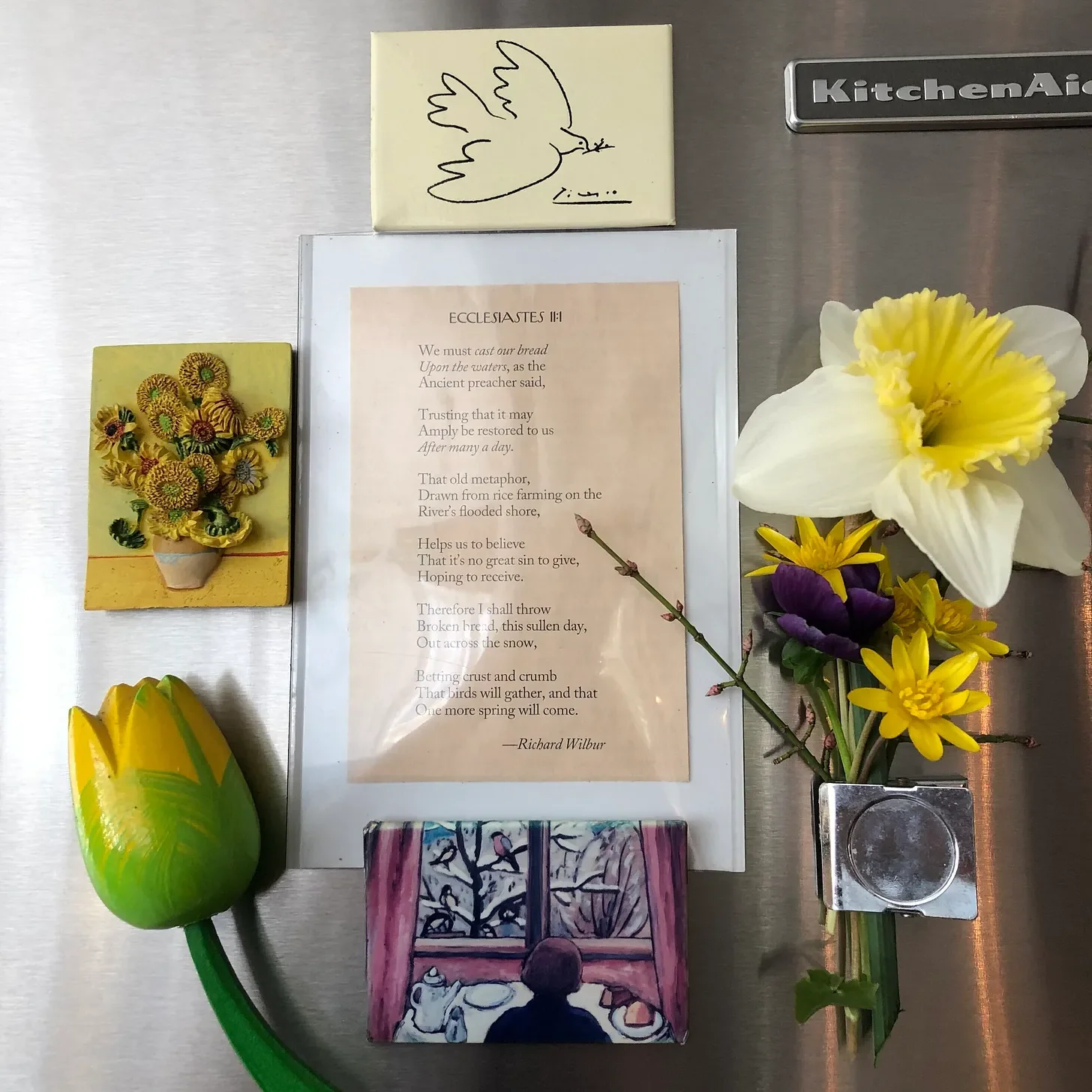
One of my mother’s favorite poems in her later years was written by Richard Wilbur, the second poet laureate of the United States. A copy clipped from the pages of The New Yorker magazine lives on my refrigerator door, decorated with any flowers that offer themselves for picking.
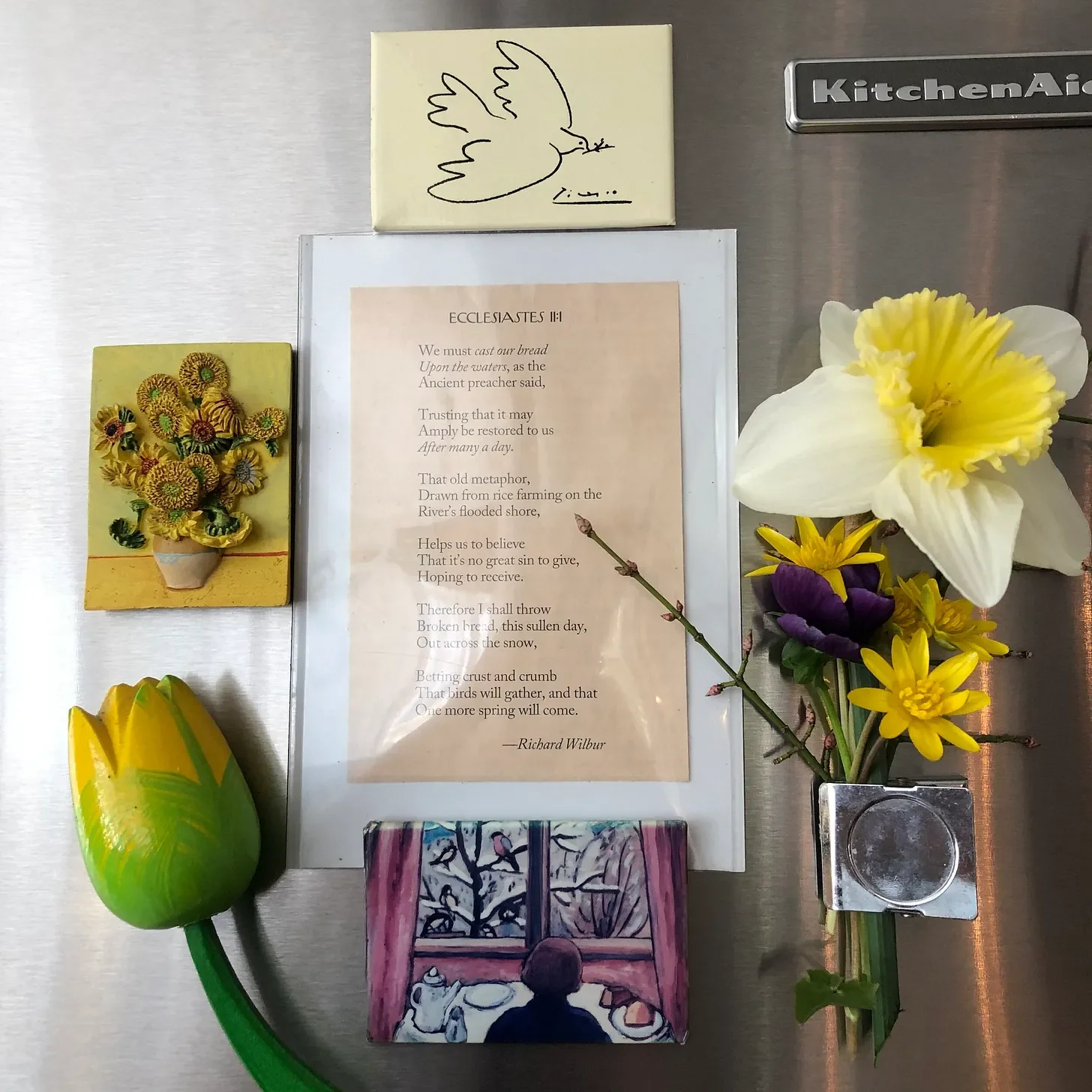
Ecclesiastes 11:1
We must cast our bread
Upon the waters, as the
Ancient preacher said,Trusting that it may
Amply be restored to us
After many a day.That old metaphor,
Drawn from rice farming on the
River’s flooded shore,Helps us to believe
That it’s no great sin to give,
Hoping to receive.Therefore I shall throw
Broken bread, this sullen day,
Out across the snow,Betting crust and crumb
That birds will gather, and that
One more spring will come.Richard Wilbur